
Humpback Whales & Calves in Costa Rica: Size, Weight, Habits & Baby Whales at Caño Island
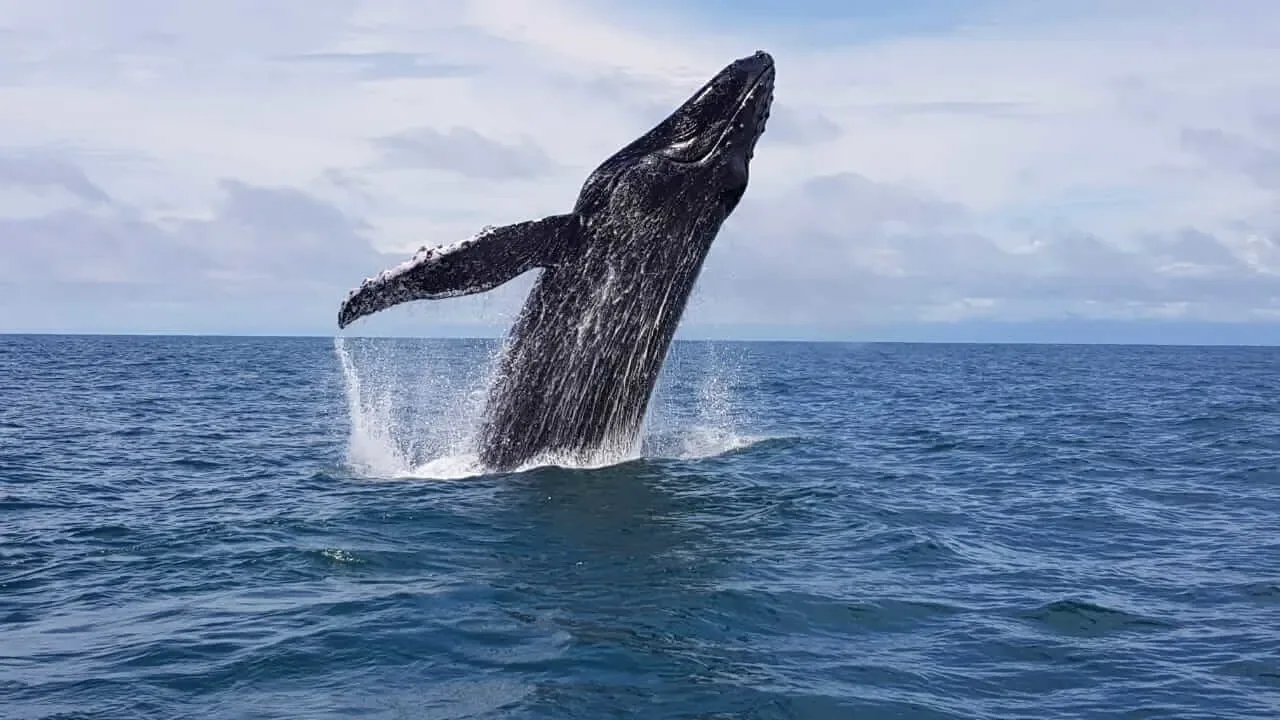
The warm, tranquil waters surrounding Caño Island Biological Reserve and the coastline of Drake Bay in Costa Rica's South Pacific represent one of the world's most critical marine nurseries for the magnificent humpback whale (Megaptera novaeangliae). Research conducted by the Center for Cetacean Research (CEIC) and the University of Costa Rica (UCR) highlights the Osa Peninsula as one of Earth's rare oceanic crossroads hosting two distinct populations of humpbacks throughout the calendar year.
📋 Quick Species Profile: Humpback Whale & Calf
Morphology, Colossal Dimensions & Female Size Advantage
Unlike land mammals, baleen whales demonstrate reverse sexual dimorphism: adult female humpbacks are noticeably longer and bulkier than males. While a mature male measures roughly 43 to 49 feet (13 to 15 meters), breeding females routinely reach 52 to 56 feet (16 to 17 meters) and weigh upwards of 80,000 pounds.
This extra layer of blubber is an evolutionary necessity. During an 11-to-12-month gestation period and months of heavy lactation in tropical breeding grounds, the mother fasts completely. She sustains herself exclusively on stored fat acquired during summer feeding in polar krill fields, transferring massive caloric reserves to her calf without hunting a single mouthful of food.
The genus name, Megaptera, translates to "giant wings." Humpback pectoral fins are the longest proportional appendages of any living vertebrate, extending up to one-third of the whale's entire length. These massive wings provide nimble maneuverability to execute sharp underwater turns, brake suddenly, and physically shield newborn calves from ocean hazards.
The Newborn Calf: Nursing, Rapid Growth & Acoustic Whispers
A newborn whale — technically referred to as a calf — enters the ocean after nearly a year of gestation. Seconds after birth, the mother gently nudges the baby to the surface using her rostrum so it can draw its very first breath through its double blowhole.
To fuel rapid weight gain of nearly 100 pounds per day, humpback milk is exceptionally rich. With a butterfat content between 40% and 53%, it has the consistency of condensed Greek yogurt. This dense texture prevents the milk from dissipating into seawater when squirted directly into the calf's mouth.
Bioacoustic researchers monitoring Golfo Dulce and Caño Island have discovered that mothers and calves converse using whispered grunts and squeaks. Unlike the thunderous operatic songs produced by courting males that reverberate across entire ocean basins, mother-calf contact calls are kept at whisper levels (up to 40 decibels quieter), safeguarding the vulnerable baby from nearby killer whales and oceanic sharks.
5 Fascinating Scientific Facts About Humpback Whales
- Fluke Fingerprints: The trailing underside of every humpback whale's tail fluke features unique black-and-white pigmentation, jagged serrations, and scarring patterns that remain unchanged throughout life, allowing scientists to track individual whales over decades.
- Earth's Greatest Mammal Migration: The Southern Hemisphere population travels over 5,300 miles (8,500 km) from Antarctica to Caño Island and back, completing one of the longest documented mammal journeys on Earth.
- Full-Body Acrobatic Breaches: Propelling a 40-ton body completely out of the sea requires immense kinetic power generated by just three or four explosive tail strokes. Breaching serves as long-distance sonic communication, territory signaling, and skin cleansing.
- Protective Altruism: Scientific marine records document dozens of occurrences where adult humpback whales deliberately swam long distances to physically protect seals, dolphins, and grey whale calves from predatory orca attacks.
- Blowhole Jet Streams: Exhaled breath bursts through the blowholes at speeds exceeding 250 mph (400 km/h), launching a towering water vapor plume 13 feet high into the coastal breeze.
Where & How to Spot Whales: From Drake Bay to Corcovado
Marine safaris to Caño Island Biological Reserve and dedicated cetacean watching tours departing from Sierpe and Drake Bay adhere to rigorous conservation regulations, idling boat engines to protect marine life.
A fantastic insider secret: during the scenic open-ocean boat transit to Corcovado National Park (Sirena and San Pedrillo stations), boats navigate the heart of the Pacific whale highway. During migration peaks (August–October and January–March), travelers frequently witness spectacular breaches, tail slaps, and playful mother-and-calf pairs right from the boat on their journey into the rainforest!
* Marine mammals roam freely in open ocean corridors; sightings occur regularly both on dedicated marine expeditions and during the boat transit to Corcovado National Park.
Frequently Asked Questions
What is a baby humpback whale called and how big is it at birth?
A baby whale is called a calf. At birth in the protected waters of Drake Bay and Caño Island, it measures 13 to 15 feet (4 to 4.5 meters) in length and weighs between 1 and 1.5 metric tons (2,200 to 3,300 lbs), roughly the size of a compact car.
How much weight does a whale calf gain per day?
A humpback calf nurses on 150 to 200 liters of mother's milk daily. Because the milk contains 40% to 50% butterfat (the consistency of thick yogurt), the calf gains an astounding 70 to 100 lbs (30 to 45 kg) of blubber and muscle every single day.
Why do humpback whales travel to Costa Rica to give birth?
Newborn calves lack the thick protective blubber needed to survive polar freezing waters. The tropical waters surrounding Caño Island and Drake Bay average 82°F to 86°F (28°C to 30°C), creating a tranquil nursery free from rough ocean swells and major marine predators.
When is the best season to spot humpback mothers and calves?
The primary migration from Antarctica spans late July through early November (peaking in August and September). A secondary migration from the North Pacific arrives between December and late March.